
Table of Contents
- Quick Guide: Arizona Energy Efficiency at a Glance
- Beating the Heat: The Future of Arizona Living in 2026
- Meet The Hassell Team AZ: Your Local Desert Experts
- Transparency and Legal Compliance
- High-Performance Heat Pumps: Can They Handle 115°F?
- The ‘Cool Roof’ Revolution: Reflective Materials and SRI
- Advanced Insulation: Is Spray Foam Worth the Investment?
- High-Tech Windows: Decoding Low-E and SHGC Metrics
- 2026 Solar Incentives and Battery Storage Integration
- Smart Home Energy Management (SHEM) Systems
- Energy-Efficient Hot Water: Heat Pump Water Heaters
- The ‘Dirt-and-All’ Reality: Real-World Efficiency in Mohave County
- Arizona Energy Efficiency FAQ
- Balancing Costs: Limitations of Efficiency Upgrades
- Final Thoughts: Future-Proofing Your Arizona Home
Quick Guide: Arizona Energy Efficiency at a Glance
- High-SEER2 Heat Pumps: Variable-speed units essential for 115°F+ days.
- Low-E Glass (SHGC < 0.23): Critical for blocking solar heat gain while preserving views.
- Spray Foam Insulation: Creates a sealed “conditioned attic” to protect ductwork.
- Cool Roof Systems: Materials with high Solar Reflectance Index (SRI) to reject UV radiation.
- Smart Energy Management: Automated load-shedding during utility peak hours.
- Heat Pump Water Heaters: Cools your garage while heating your water.
- Solar + Battery Storage: Necessary to maximize ROI under 2026 net billing rules.
Key Takeaway: These 7 upgrades align with 2026 Arizona building codes and federal incentive windows, offering the surest path to lower bills and higher resale value in Mohave County.
Beating the Heat: The Future of Arizona Living in 2026
To combat Arizona’s extreme 2026 temperatures, homeowners should prioritize variable-speed heat pumps with high SEER2 ratings, Low-E windows with a Solar Heat Gain Coefficient (SHGC) below 0.23, and spray foam insulation (R-38 or higher). According to 2026 energy data, these specific upgrades can reduce cooling costs by up to 40% in Mohave County’s desert climate. This guide details the top 7 features, from reflective roofing to smart energy management, that maximize comfort and property value.
The definition of “move-in ready” in Bullhead City and Kingman has shifted dramatically. Extreme heat days are becoming more frequent, making energy efficiency a necessity rather than a luxury for protecting home value. In the past, a working AC unit was enough; today, buyers are looking for “desert-proof” housing that can withstand 120-degree peaks without bankrupting the owner. As a team deeply rooted in this soil, we see firsthand that homes lacking these modern efficiency standards sit longer on the market. If you are curious about how your current home stacks up in this evolving market, you might want to check What is My Home Worth? – Hassell Team AZ to gauge its current standing.
Meet The Hassell Team AZ: Your Local Desert Experts
We are The Hassell Team AZ, a “family crew” of real estate professionals led by lifelong local Arianna Romero. Affiliated with Keller Williams Arizona Living Realty, we specialize in the unique challenges of Mohave County real estate, from riverfront properties in Bullhead City to the high desert terrain of Kingman. Unlike distant call-center agents, we offer “dirt-and-all” support, meaning we understand the gritty reality of septic tanks, monsoon dust, and the difference between stick-built and manufactured home efficiency. We don’t just sell homes; we help neighbors build lives in the desert we call home.
Transparency and Legal Compliance
As licensed real estate professionals, we adhere strictly to the regulations set forth by the Arizona Department of Real Estate (ADRE). While we provide guidance on home features that add value and comfort, we are not licensed HVAC contractors or solar engineers. All technical specifications regarding energy systems should be verified with licensed professionals. Our advice aligns with the disclosure requirements found in the Arizona Real Estate Law Book 2025, ensuring that you have accurate, legally compliant information regarding property conditions and material facts.
High-Performance Heat Pumps: Can They Handle 115°F?
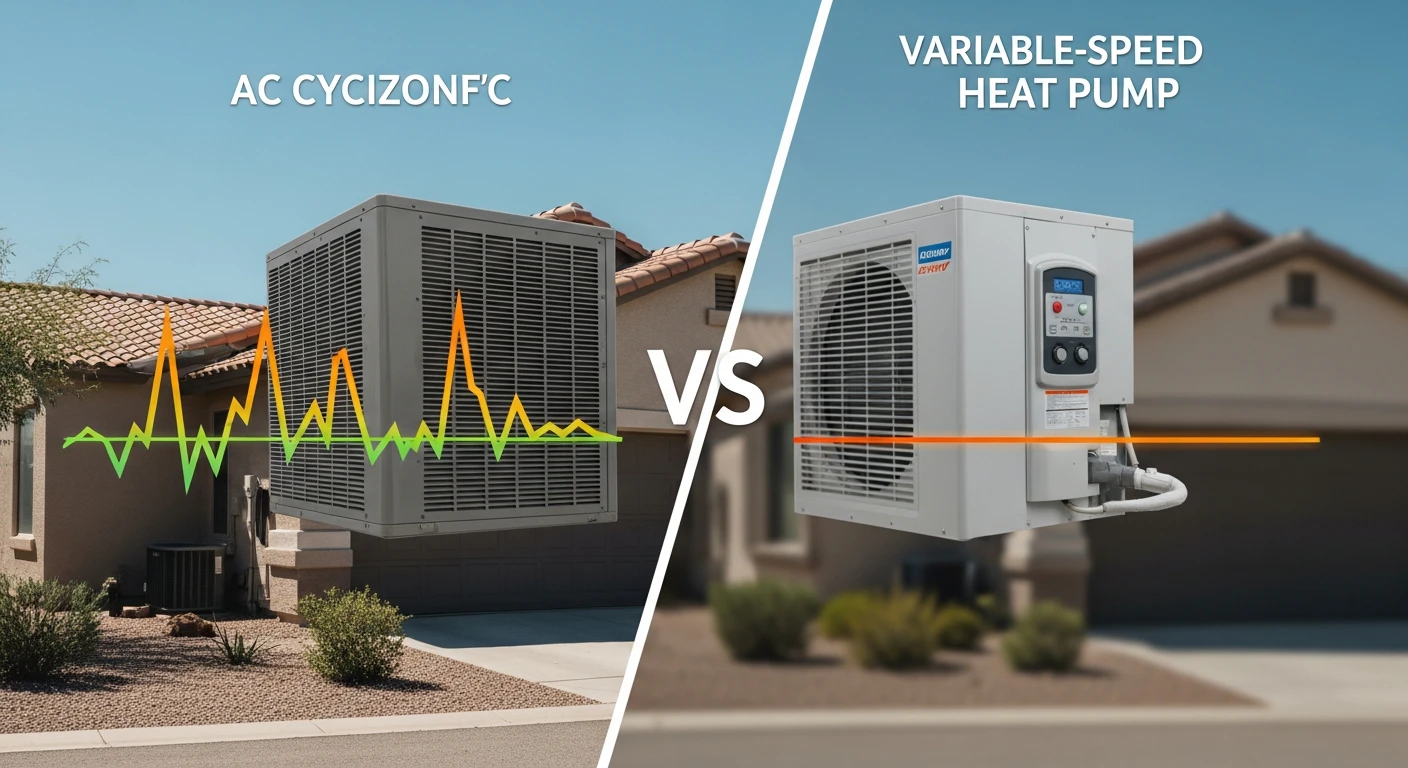
High-performance heat pumps with variable-speed compressors are the only cooling systems capable of maintaining peak efficiency when Bullhead City temperatures hit 115°F. Unlike single-stage units that cycle on and off, 2026 SEER2-rated systems run continuously at lower speeds, removing 40% more humidity and reducing energy consumption by roughly 25%. For Mohave County homeowners, this technology prevents the “thermal drift” that occurs when older AC units fail to keep up with peak afternoon heat loads.
The Shift to SEER2
The transition to SEER2 (Seasonal Energy Efficiency Ratio 2) standards has redefined what “efficient” means. The testing conditions for SEER2 are more rigorous, accurately reflecting the high static pressure found in real-world duct systems. In the past, a heat pump might have been rated SEER 18 but performed like a SEER 14 due to poor installation or extreme heat. Modern SEER2 units are designed to deliver their rated efficiency even when the mercury climbs past 110°F.
Variable-Speed vs. Single-Stage
- In the desert, the “start-stop” cycle of a traditional air conditioner is an energy killer. Every time a standard AC kicks on, it draws a massive surge of power (amperage).
- Standard AC: Blasts 100% capacity, cools quickly, shuts off. Humidity remains high; temperature swings are noticeable.
- Variable-Speed Heat Pump: Ramps up gently, runs at 40-60% capacity for longer periods. Keeps the home consistently cool and dry.
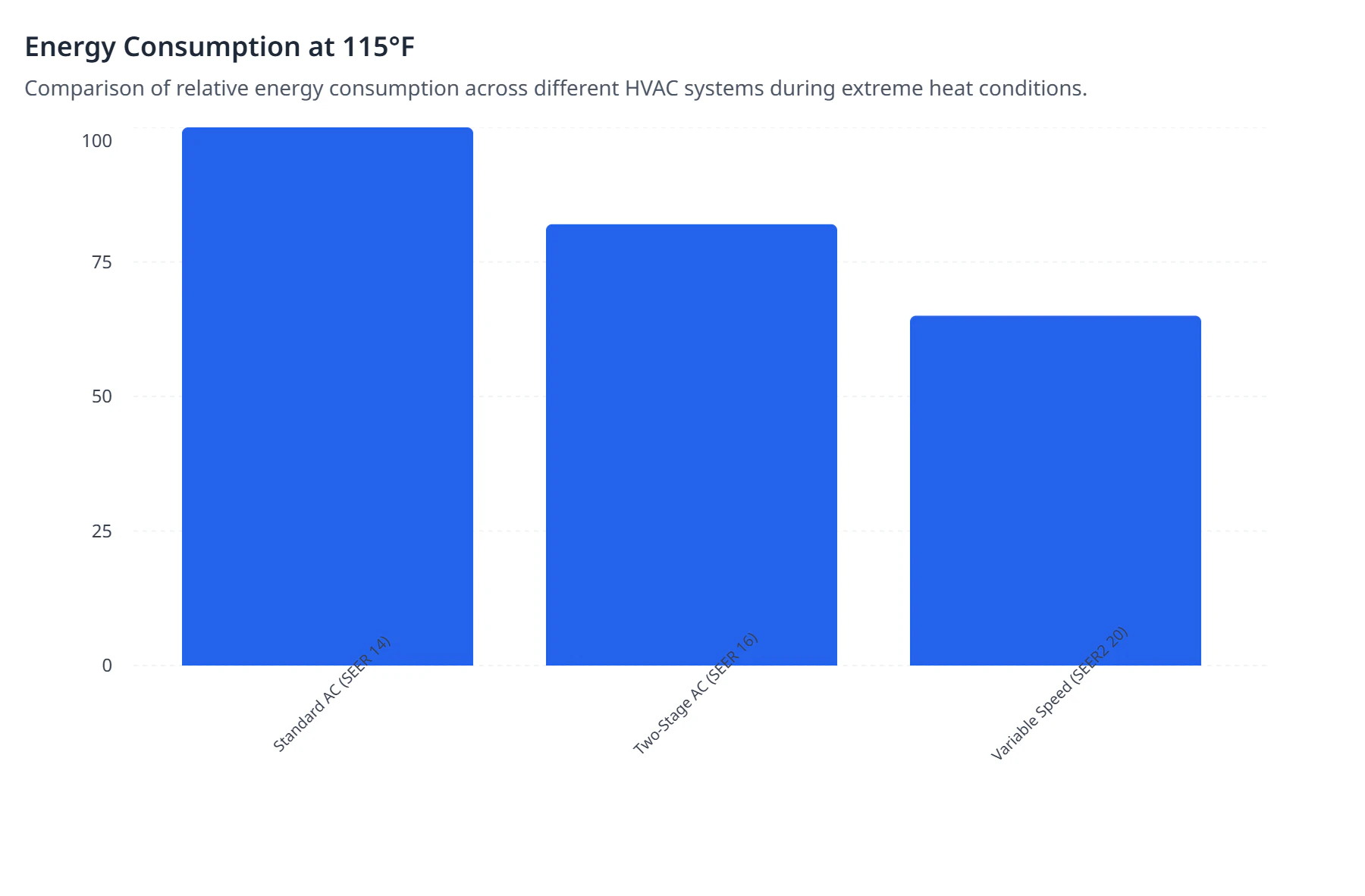
Comparison of relative energy consumption across different HVAC systems during extreme heat conditions.
For Arizona residents, the ability of a modern heat pump to extract heat even in extreme temperatures makes it a superior choice over older straight-cool ACs with gas furnaces, especially given the efficiency of electric heating during our mild winters.
The ‘Cool Roof’ Revolution: Reflective Materials and SRI
Cool roof systems utilizing materials with a Solar Reflectance Index (SRI) above 90 are critical for rejecting the intense solar radiation of the Arizona desert. Studies show that reflective roofing can lower attic temperatures by up to 50°F, directly reducing the cooling load on HVAC equipment located in unconditioned spaces. Choosing the right reflective material is the first line of defense against the conductive heat soak that spikes July energy bills.
Understanding Thermal Radiation
- In Bullhead City, the sun acts like a hammer. A standard dark asphalt shingle absorbs that energy, transferring it directly into the attic structure. By 4:00 PM, your insulation is battling a heat load of 150°F+ radiating from the roof deck.
- High SRI Materials: White concrete tiles, reflective metal roofing, or asphalt shingles with specialized reflective granules.
- Impact: These materials bounce solar energy back into the atmosphere before it is absorbed.
Material Comparison for Mohave County
When we look at Stick Builds – Hassell Team AZ, the choice of roofing material is often the single biggest factor in long-term energy performance.
| Roofing Material | Typical SRI | Durability in the Desert | Cost Profile |
|---|---|---|---|
| Standard Asphalt Shingle | 10-20 | Low (dries out) | Low |
| “Cool” Asphalt Shingle | 25-30 | Medium | Moderate |
| Concrete Tile (Terra Cotta) | 35-50 | High | Moderate-High |
| White Metal / TPO | 80-100+ | Very High | High |
For 2026, we are seeing a surge in “Cool” concrete tiles that look traditional but possess high-tech reflective coatings.
Advanced Insulation: Is Spray Foam Worth the Investment?
Spray foam insulation creates a sealed building envelope that outperforms traditional fiberglass batting by eliminating air leakage in desert homes. By moving the thermal boundary to the underside of the roof deck, spray foam reduces HVAC sizing requirements and lowers energy costs by an average of 20% in Climate Zone 2. While the upfront cost is higher, the creation of a “conditioned attic” protects ductwork from extreme heat and prevents dust infiltration during the monsoon season.
Open-Cell vs. Closed-Cell
- In Arizona, open-cell foam is commonly used for roof decks because it allows for some breathability while stopping air movement. Closed-cell is denser and provides a higher R-value per inch, adding structural rigidity.
- The Conditioned Attic: By spraying the underside of the roof, your attic becomes a semi-conditioned space (usually within 5-10 degrees of the living area).
- Ductwork Protection: Your ducts are no longer running through a 150-degree oven, meaning the air coming out of your vents is significantly cooler.
R-Value and Air Sealing
It is not just about R-value (thermal resistance); it is about air sealing. Fiberglass batts allow hot air to filter through gaps. Spray foam expands to fill every crack. This is one of the most effective Remodeling Projects That Will Boost Your Home’s Value, as educated buyers now specifically ask for “spray foam” when touring homes in Kingman and Fort Mohave.
High-Tech Windows: Decoding Low-E and SHGC Metrics
High-efficiency windows in 2026 must feature a Solar Heat Gain Coefficient (SHGC) below 0.23 to effectively block the invisible infrared heat that penetrates standard glass. While U-factor measures insulation against cold, the SHGC is the primary metric for desert survival, determining how much solar radiation enters the home. Installing triple-pane or advanced double-pane windows with argon gas fills can reduce heat transfer by nearly 50% compared to standard builder-grade aluminum windows.
Why SHGC Matters More Than R-Value
- In the Northeast, you want windows that keep heat in. In Arizona, we want windows that keep heat out.
- Low-E (Low Emissivity): A microscopic metallic coating that reflects infrared light.
- The 0.23 Standard: For 2026, ensure your window sticker reads an SHGC of 0.23 or lower. Anything higher allows too much thermal energy to pass through, forcing your AC to work overtime.
Frame Materials
Vinyl and fiberglass frames are superior to aluminum in our climate. Aluminum conducts heat rapidly—touch an aluminum window frame in July, and you’ll burn your hand. Vinyl and fiberglass act as insulators, breaking the thermal bridge between the scorching outside air and your cool living room.
2026 Solar Incentives and Battery Storage Integration
Residential solar systems in 2026 require integrated battery storage to achieve a viable Return on Investment (ROI) due to Arizona’s evolved “net billing” utility structures. While the Federal Investment Tax Credit (ITC) remains a powerful 30% incentive, local utilities now pay wholesale rates for exported power, making it financially essential to store your own solar energy for evening use. A properly sized system with a battery like the Tesla Powerwall 3 allows homeowners to bypass peak-demand charges entirely.
The Death of Net Metering
- Gone are the days when you could spin your meter backward at retail rates. Under current net billing:
- Export Rate: You sell excess power to the grid at roughly 3-8 cents/kWh.
- Import Rate: You buy power from the grid in the evening at 12-28 cents/kWh.
- The Battery Solution: Batteries allow you to “time-shift” your solar energy. You charge the battery when the sun is up and drain it from 4 PM to 9 PM, avoiding the high utility rates.
Smart Home Energy Management (SHEM) Systems
Smart Home Energy Management (SHEM) systems have evolved beyond simple thermostats to become whole-home operating systems that actively manage electrical loads to prevent peak-hour surcharges. By connecting to the main electrical panel, systems like Span or Emporia Vue can automatically pause high-draw appliances—like pool pumps or EV chargers—when energy prices are highest. This automation transforms a passive home into an active participant in energy efficiency, saving homeowners hundreds of dollars annually without manual intervention.
Beyond the Thermostat. While a Nest or Ecobee is a great start, 2026 tech goes deeper.
- Circuit-Level Monitoring: See exactly how much power your dryer or pool pump is using in real-time.
- Automated Load Shedding: Program the system to cut power to the water heater if the total home consumption exceeds a certain threshold, ensuring you never trigger a “demand charge” from the utility company.
Energy-Efficient Hot Water: Heat Pump Water Heaters
Heat pump water heaters (HPWH) are uniquely suited for the Arizona climate because they generate hot water by extracting heat from the surrounding air, effectively acting as a small air conditioner for your garage. These units are 2-3 times more efficient than standard electric resistance heaters, using electricity to move heat rather than create it. For a garage in Bullhead City that stays hot year-round, an HPWH provides the dual benefit of virtually free hot water and a cooler workspace.
The “Free” Cooling Effect
- The exhaust from a heat pump water heater is cool, dry air.
- Summer Benefit: If installed in the garage, it can drop the garage temperature by 5-10 degrees while running.
- Efficiency: Since the ambient air is already hot (energy-rich), the water heater doesn’t have to work hard to extract heat, giving it a phenomenal efficiency rating in our climate.
The ‘Dirt-and-All’ Reality: Real-World Efficiency in Mohave County
The theoretical efficiency of a home often clashes with the “dirt-and-all” reality of living in the Mohave Desert. We see this constantly when comparing different construction types.
Stick Builds vs. Manufactured Homes
- Efficiency profiles differ wildly here.
- Stick Builds: Traditional 2×6 construction allows for deeper wall insulation and easier implementation of spray foam and heavy masonry. If you are looking to build from scratch, check out our resources on Stick Builds – Hassell Team AZ.
- Manufactured Homes: Modern manufactured homes are built to HUD codes that have improved, but older models (pre-1990) are notorious energy sieves. However, newer “Energy Star” rated manufactured homes utilize 2×6 sidewalls and upgraded insulation packages that rival site-built homes. For a look at modern standards, visit our page on New Builds.
The Dust Factor in Bullhead City and Kingman, dust is an energy killer.
- Solar Panels: A layer of desert dust can reduce solar output by 15-20%. They need regular rinsing.
- HVAC Coils: The fine silt from monsoons clogs condenser coils faster here than anywhere else. “Efficiency” in Arizona requires a strict maintenance schedule—changing filters monthly is not a suggestion; it’s a requirement to keep your SEER rating valid.
Arizona Energy Efficiency FAQ
Where is the best place to live in Arizona for the weather?
If you want to escape the most brutal heat, higher elevations like Kingman (approx. 3,300 ft) offer temperatures 10-15 degrees cooler than the Phoenix or Bullhead City valleys. However, for those who love water sports and don’t mind the heat, Bullhead City offers the cooling influence of the Colorado River, though ambient air temperatures remain high.
What kind of house would be best in a hot desert climate?
The most energy-efficient design for our climate is a home with high thermal mass (like masonry or ICF – Insulated Concrete Forms) and deep overhangs. Orientation is key: minimizing West-facing windows prevents the harshest afternoon sun from entering the home.
What is the most energy-efficient house design?
A compact, rectangular design with the long axis running East-West maximizes passive solar protection. Coupled with a “conditioned attic” (spray foam) and a cool roof, this design minimizes the surface area exposed to direct sun and keeps the ductwork inside the thermal envelope.
Do houses in Arizona have insulation?
Yes, but older homes (pre-2000) often have inadequate fiberglass batting (R-19 in ceilings). Modern codes and energy-efficient retrofits aim for R-38 to R-60 in attics. If your home feels hot quickly after the AC turns off, your insulation is likely insufficient or settled.
Are manufactured homes a good investment in Mohave County?
Yes, provided you own the land. Modern manufactured homes offer excellent value and improved efficiency standards. However, placing a manufactured home on a “lease land” lot can limit appreciation. We always recommend owning the dirt underneath your home.
What should first-time homebuyers look for in the Arizona desert market?
Look for North/South exposure. A home facing North/South takes significantly less solar heat gain than one facing East/West. Also, check the age of the HVAC unit—if it’s over 12 years old in Arizona, it is living on borrowed time.
Balancing Costs: Limitations of Efficiency Upgrades
- While we champion efficiency, the “payback period” must make sense. Not every upgrade is right for every homeowner.
- Windows: Replacing all windows can cost $20,000+. If your frames are decent, installing solar screens (90% block) for $2,000 might give you 80% of the benefit for 10% of the cost.
- Solar: If you plan to move in 3 years, a 20-year solar loan might complicate your sale more than it helps.
- Over-Improving: Don’t put a $50,000 eco-overhaul into a home in a neighborhood where prices are capped.
Always weigh the monthly savings against the upfront cash. Sometimes, simply air-sealing your doors and adding blown-in insulation is the smartest financial move.
Final Thoughts: Future-Proofing Your Arizona Home
Implementing these 7 energy-efficient features isn’t just about surviving the summer of 2026; it’s about securing your investment against rising utility costs and shifting buyer expectations. Whether you choose to upgrade your insulation, install a high-SEER2 heat pump, or invest in a full solar-battery system, each step moves you closer to a “desert-proof” home. The Hassell Team is here to help you navigate these choices with the honest, “dirt-and-all” advice our neighbors rely on.
Ready to find a home that keeps your bills low and your comfort high? Start Your Search with our local family crew today.